
What Is Open Interest (OI) and How to Read It? (Smart Traders Are Searching This!)
Open Interest (OI) is one of the most powerful but underrated indicators in futures and options trading. Smart traders don’t just look at price… they look at What Is Open Interest to understand where real money is flowing. When OI moves, market psychology reveals itself — and those signals can guide your entries, exits, and risk management like a pro.
Let’s decode it in the simplest, most actionable way. start “What Is Open Interest“
What Is Open Interest? (The Real Definition Traders Use)
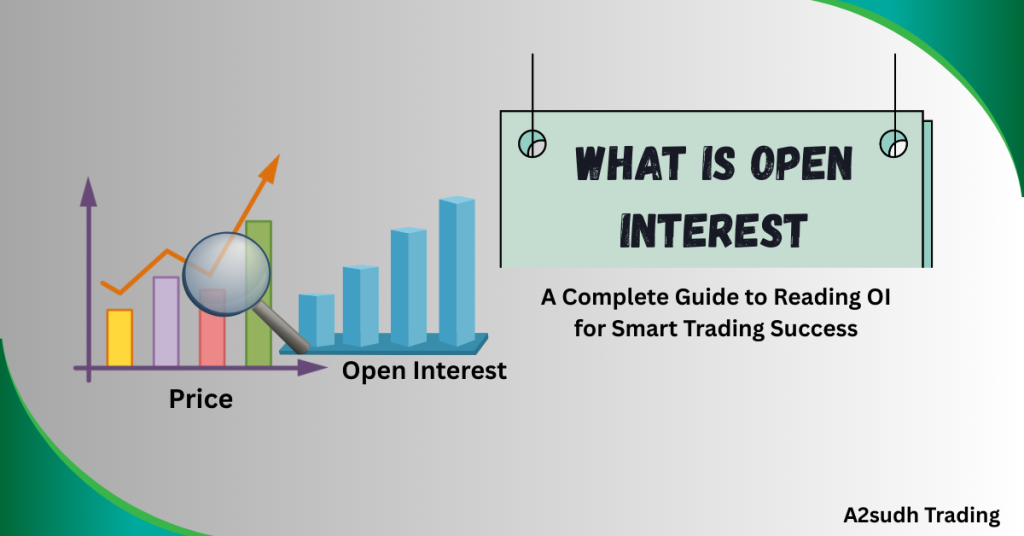
Open Interest refers to the total number of outstanding open contracts in futures and options at any moment.
If new positions are created → OI goes up.
If positions are closed → OI goes down.
It tells you:
- How active the market is
- How many traders have positions still “alive”
- Where big players may be building momentum
Price shows direction. OI shows conviction.
When both work together = stronger market signals.
How Does Open Interest Work?
Each contract has a buyer and a seller.
When both open a new trade → +1 OI
When both exit their trade → –1 OI
Example:
- If traders add 1,000 new BankNifty Call contracts
→ OI increases → bullish money flow
OI always tracks live participation.
How to Read Open Interest with Price? (Smartest Strategy)
Here’s the simplest price vs OI logic used by pro traders:
| Price Action | OI Movement | Market Signal | Meaning |
|---|---|---|---|
| Price ↑ | OI ↑ | Strong Uptrend | Long positions adding |
| Price ↓ | OI ↑ | Strong Downtrend | Short positions adding |
| Price ↑ | OI ↓ | Weak Uptrend | Short covering only |
| Price ↓ | OI ↓ | Weak Downtrend | Long unwinding |
🧠 Pro Tip: Only price without OI = noise. Price + OI = reliability.
Why Open Interest Is a Game-Changer for Traders
- Identifies big players’ intentions
- Confirms trend continuation or reversal
- Helps predict breakout vs. fake-out
- Shows fear vs. confidence in the market
- Supports risk management with clear data
If retail buys but institutions sell — OI reveals the truth.
Why Traders Must Track OI in Options?
Because options decay fast.
Price may show strength, but if OI drops, the move may be weak.
Call OI rising at a strike price = resistance area
Put OI rising at a strike price = strong support zone
That’s why Options Chain OI is a weapon for intraday traders.
Actionable Tips to Use Open Interest Like a Pro
✔ Always read OI with price and volume
✔ Watch major shifts at key support/resistance zones
✔ Avoid trades with falling OI — momentum may be dying
✔ Use OI charts before entering any breakout trade
✔ Combine OI with risk management to protect profits
Small observation = big edge.
Conclusion: Open Interest Is the Smart Trader’s X-Ray Vision
If you truly want consistency in futures and options, stop trading blindly. What Is Open Interest is not just a definition — it’s a roadmap to market strength, conviction, and What Is Open Interest are real money flow.
Use it daily.
Master the price + OI logic.
And watch how your trading decisions become sharper, cleaner, and more profitable.
Don’t miss this edge — the market is already revealing its next move. Use Open Interest to catch it before the crowd.
🧩 FAQs Traders Search Every Day
Is high Open Interest good or bad?
Not good or bad — it simply shows high participation. Interpretation depends on price direction.
Does rising OI always mean bullish momentum?
No. Rising OI with falling price = aggressive short selling.
Can Open Interest predict a trend reversal?
Yes. When price moves but OI does the opposite → reversal signals appear.
Is Open Interest better for futures or options?
Best for both — but in options, pairing OI with strike levels is even more powerful.